Pages

Posts mit dem Label Monsanto werden angezeigt. Alle Posts anzeigen

Donnerstag, 11. Juli 2013

A New Earthquake Hits Haiti: Monsanto’s deadly gift of 475 tons of genetically-modified seeds to Haitian farmers

by Fr. Jean-Yves Urfie


Haiti’s earthquake on 12 January this year has been a lucky business break for some. The transnational firm Monsanto is offering the country’s farmers a deadly gift of 475 tones of genetically-modified (GM) seeds, along with associated fertilizer and pesticides, which will be handed out free by the WINNER project, with the backing of the US embassy in Haiti. Do Haitians know Monsanto made the “Agent Orange” defoliant sprayed over Vietnam by US planes during the war there, poisoning both US soldiers and Vietnamese civilians?

Do Haitians know that these GM seeds have been declared dangerous by many countries? They often come in kits along with a Monsanto herbicide called “Roundup,” which contains glyphosate. In my native Brittany, it has already polluted the water table. But Monsanto insists its product is biodegradable. It is being sued for this by anti-fraud officials in Lyon.

Monsanto has already begun distributing its GM maize seeds around Gonaives, Kenscoff, Pétionville, Cabaret, Arcahaie, Croix-des-Bouquets and Mirebalais. Soon there will be only Monsanto seeds in Haiti. Then it will be goodbye to farmers’ independence. Monsanto recently invested $550 million in Brazil to manufacture the Roundup herbicide in the northeastern state of Bahia. But the country seems to be fighting back against the firm.

Monsanto is publicizing the seeds as a generous gift. But Haitian farmers wishing to use them for future harvests will have to pay royalties to Monsanto. The Monsanto representative in Haiti is Jean- Robert Estimé, who served as foreign minister under the Duvalier family’s 29-year dictatorship.

http://www.globalresearch.ca/a-new-earthquake-hits-haiti-monsanto-s-deadly-gift-of-475-tons-of-genetically-modified-seeds-to-haitian-farmers/19113

The GM genocide: Thousands of Indian farmers are committing suicide after using genetically modified crops

by Andrew Malone


When Prince Charles claimed thousands of Indian farmers were killing themselves after using GM crops, he was branded a scaremonger. In fact, as this chilling dispatch reveals, it’s even WORSE than he feared.

The children were inconsolable. Mute with shock and fighting back tears, they huddled beside their mother as friends and neighbours prepared their father’s body for cremation on a blazing bonfire built on the cracked, barren fields near their home.

As flames consumed the corpse, Ganjanan, 12, and Kalpana, 14, faced a grim future. While Shankara Mandaukar had hoped his son and daughter would have a better life under India’s economic boom, they now face working as slave labour for a few pence a day. Landless and homeless, they will be the lowest of the low.

Human tragedy: A farmer and child in India’s ‘suicide belt’

Shankara, respected farmer, loving husband and father, had taken his own life. Less than 24 hours earlier, facing the loss of his land due to debt, he drank a cupful of chemical insecticide.

Unable to pay back the equivalent of two years’ earnings, he was in despair. He could see no way out.

There were still marks in the dust where he had writhed in agony. Other villagers looked on – they knew from experience that any intervention was pointless – as he lay doubled up on the ground, crying out in pain and vomiting.

Moaning, he crawled on to a bench outside his simple home 100 miles from Nagpur in central India. An hour later, he stopped making any noise. Then he stopped breathing. At 5pm on Sunday, the life of Shankara Mandaukar came to an end.

As neighbours gathered to pray outside the family home, Nirmala Mandaukar, 50, told how she rushed back from the fields to find her husband dead. ‘He was a loving and caring man,’ she said, weeping quietly.

‘But he couldn’t take any more. The mental anguish was too much. We have lost everything.’

Shankara’s crop had failed – twice. Of course, famine and pestilence are part of India’s ancient story.

But the death of this respected farmer has been blamed on something far more modern and sinister: genetically modified crops.

Shankara, like millions of other Indian farmers, had been promised previously unheard of harvests and income if he switched from farming with traditional seeds to planting GM seeds instead.

Beguiled by the promise of future riches, he borrowed money in order to buy the GM seeds. But when the harvests failed, he was left with spiralling debts – and no income.

So Shankara became one of an estimated 125,000 farmers to take their own life as a result of the ruthless drive to use India as a testing ground for genetically modified crops.

The crisis, branded the ‘GM Genocide’ by campaigners, was highlighted recently when Prince Charles claimed that the issue of GM had become a ‘global moral question’ – and the time had come to end its unstoppable march.

Speaking by video link to a conference in the Indian capital, Delhi, he infuriated bio-tech leaders and some politicians by condemning ‘the truly appalling and tragic rate of small farmer suicides in India, stemming… from the failure of many GM crop varieties’.

Ranged against the Prince are powerful GM lobbyists and prominent politicians, who claim that genetically modified crops have transformed Indian agriculture, providing greater yields than ever before.

The rest of the world, they insist, should embrace ‘the future’ and follow suit.

So who is telling the truth? To find out, I travelled to the ‘suicide belt’ in Maharashtra state.

What I found was deeply disturbing – and has profound implications for countries, including Britain, debating whether to allow the planting of seeds manipulated by scientists to circumvent the laws of nature.

For official figures from the Indian Ministry of Agriculture do indeed confirm that in a huge humanitarian crisis, more than 1,000 farmers kill themselves here each month.

Simple, rural people, they are dying slow, agonising deaths. Most swallow insecticide – a pricey substance they were promised they would not need when they were coerced into growing expensive GM crops.

It seems that many are massively in debt to local money-lenders, having over-borrowed to purchase GM seed.

Pro-GM experts claim that it is rural poverty, alcoholism, drought and ‘agrarian distress’ that is the real reason for the horrific toll.

But, as I discovered during a four-day journey through the epicentre of the disaster, that is not the full story.

Death seeds: A Greenpeace protester sprays milk-based paint on a Monsanto research soybean field near Atlantic, Iowa
In one small village I visited, 18 farmers had committed suicide after being sucked into GM debts. In some cases, women have taken over farms from their dead husbands – only to kill themselves as well.

Latta Ramesh, 38, drank insecticide after her crops failed – two years after her husband disappeared when the GM debts became too much.

She left her ten-year-old son, Rashan, in the care of relatives. ‘He cries when he thinks of his mother,’ said the dead woman’s aunt, sitting listlessly in shade near the fields.

Village after village, families told how they had fallen into debt after being persuaded to buy GM seeds instead of traditional cotton seeds.

The price difference is staggering: £10 for 100 grams of GM seed, compared with less than £10 for 1,000 times more traditional seeds.

But GM salesmen and government officials had promised farmers that these were ‘magic seeds’ – with better crops that would be free from parasites and insects.

Indeed, in a bid to promote the uptake of GM seeds, traditional varieties were banned from many government seed banks.

The authorities had a vested interest in promoting this new biotechnology. Desperate to escape the grinding poverty of the post-independence years, the Indian government had agreed to allow new bio-tech giants, such as the U.S. market-leader Monsanto, to sell their new seed creations.

In return for allowing western companies access to the second most populated country in the world, with more than one billion people, India was granted International Monetary Fund loans in the Eighties and Nineties, helping to launch an economic revolution.

But while cities such as Mumbai and Delhi have boomed, the farmers’ lives have slid back into the dark ages.

Though areas of India planted with GM seeds have doubled in two years – up to 17 million acres – many famers have found there is a terrible price to be paid.

Far from being ‘magic seeds’, GM pest-proof ‘breeds’ of cotton have been devastated by bollworms, a voracious parasite.

Nor were the farmers told that these seeds require double the amount of water. This has proved a matter of life and death.

With rains failing for the past two years, many GM crops have simply withered and died, leaving the farmers with crippling debts and no means of paying them off.

Having taken loans from traditional money lenders at extortionate rates, hundreds of thousands of small farmers have faced losing their land as the expensive seeds fail, while those who could struggle on faced a fresh crisis.

When crops failed in the past, farmers could still save seeds and replant them the following year.

But with GM seeds they cannot do this. That’s because GM seeds contain so- called ‘terminator technology’, meaning that they have been genetically modified so that the resulting crops do not produce viable seeds of their own.

As a result, farmers have to buy new seeds each year at the same punitive prices. For some, that means the difference between life and death.

Take the case of Suresh Bhalasa, another farmer who was cremated this week, leaving a wife and two children.

As night fell after the ceremony, and neighbours squatted outside while sacred cows were brought in from the fields, his family had no doubt that their troubles stemmed from the moment they were encouraged to buy BT Cotton, a geneticallymodified plant created by Monsanto.

‘We are ruined now,’ said the dead man’s 38-year-old wife. ‘We bought 100 grams of BT Cotton. Our crop failed twice. My husband had become depressed. He went out to his field, lay down in the cotton and swallowed insecticide.’

Villagers bundled him into a rickshaw and headed to hospital along rutted farm roads. ‘He cried out that he had taken the insecticide and he was sorry,’ she said, as her family and neighbours crowded into her home to pay their respects. ‘He was dead by the time they got to hospital.’

Asked if the dead man was a ‘drunkard’ or suffered from other ‘social problems’, as alleged by pro-GM officials, the quiet, dignified gathering erupted in anger. ‘No! No!’ one of the dead man’s brothers exclaimed. ‘Suresh was a good man. He sent his children to school and paid his taxes.

‘He was strangled by these magic seeds. They sell us the seeds, saying they will not need expensive pesticides but they do. We have to buy the same seeds from the same company every year. It is killing us. Please tell the world what is happening here.’

Monsanto has admitted that soaring debt was a ‘factor in this tragedy’. But pointing out that cotton production had doubled in the past seven years, a spokesman added that there are other reasons for the recent crisis, such as ‘untimely rain’ or drought, and pointed out that suicides have always been part of rural Indian life.

Officials also point to surveys saying the majority of Indian farmers want GM seeds – no doubt encouraged to do so by aggressive marketing tactics.

During the course of my inquiries in Maharastra, I encountered three ‘independent’ surveyors scouring villages for information about suicides. They insisted that GM seeds were only 50 per cent more expensive – and then later admitted the difference was 1,000 per cent.

(A Monsanto spokesman later insisted their seed is ‘only double’ the price of ‘official’ non-GM seed – but admitted that the difference can be vast if cheaper traditional seeds are sold by ‘unscrupulous’ merchants, who often also sell ‘fake’ GM seeds which are prone to disease.)

With rumours of imminent government compensation to stem the wave of deaths, many farmers said they were desperate for any form of assistance. ‘We just want to escape from our problems,’ one said. ‘We just want help to stop any more of us dying.’

Prince Charles is so distressed by the plight of the suicide farmers that he is setting up a charity, the Bhumi Vardaan Foundation, to help those affected and promote organic Indian crops instead of GM.

India’s farmers are also starting to fight back. As well as taking GM seed distributors hostage and staging mass protests, one state government is taking legal action against Monsanto for the exorbitant costs of GM seeds.

This came too late for Shankara Mandauker, who was 80,000 rupees (about £1,000) in debt when he took his own life. ‘I told him that we can survive,’ his widow said, her children still by her side as darkness fell. ‘I told him we could find a way out. He just said it was better to die.’

But the debt does not die with her husband: unless she can find a way of paying it off, she will not be able to afford the children’s schooling. They will lose their land, joining the hordes seen begging in their thousands by the roadside throughout this vast, chaotic country.

Cruelly, it’s the young who are suffering most from the ‘GM Genocide’ – the very generation supposed to be lifted out of a life of hardship and misery by these ‘magic seeds’.

Here in the suicide belt of India, the cost of the genetically modified future is murderously high.

http://www.dailymail.co.uk/news/article-1082559/The-GM-genocide-Thousands-Indian-farmers-committing-suicide-using-genetically-modified-crops.html

KILLER SEEDS: The Devastating Impacts of Monsanto’s Genetically Modified Seeds in India

by Iqbal Ahmed


Monsanto’s operation in India illustrates monopolization and manipulation of the market economy, tradition, technology, and misgovernance. The world’s largest producer of genetically engineered seeds has been selling genetically modified (GM) in India for the last decade to benefit the Indian farmers – or so the company claims.

In a country of more than 550 million farmers who are largely poor and uneducated and the agriculture market rife with inefficient business practices, the Indian government sought to reform the market by eliminating subsidies and loans to the farmers.

The government reform did not help the farmers. With pressure from the World Bank and International Monetary Fund (IMF), the Indian government has “forced market liberalization on India which means the elimination of government subsidies and government-backed loans to farmers.”

Enter Monsanto with its “magic” GM seeds to transform the lives of the poor Indian farmers.

The U.S. agri-business giant took full advantage of its entry into the Indian market. It entered into an agreement with state governments including Rajasthan and Andhara Pradesh to introduce a Memorandum of Understanding (MOU) that dictated the terms of disseminating the GM technology in Indian market.

For Monsanto, it is one thing to convince farmers to use artificial seeds for the purposes of enriching their lives, it is quite another to manipulate nature and technology to profit from them.

Killer Seeds

The irony is GM seeds have not been effective in India and the consequences are not as rosy as what Monsanto had promised to deliver. Scathing reports of mass suicides of  Indian farmers broke out as recently as three years ago when scores of farmers took their own lives in order to escape the burden of high prices and failure of Monsanto’s GM seeds.

Monsanto offered its GM seeds to the farmers of India with hopes of reaping plentiful crops. Plain and mostly uneducated farmers thought Monsanto had come to provide a “magic” formula that would transform their lives. They had no idea what was coming.

Monsanto’s seeds in India did not produce what the company had promised and farmers hoped. The expensive seeds piled up debts and destroyed farming fields. In many instances, the crops simply failed to materialize. The farmers were not aware that the GM seeds required more water than the traditional seeds. And lack of rain in many parts of India exacerbated the crop failure.

With no harvest, the farmers could not pay back the lenders. Burdened with debts and humiliation, the farmers simply took their own lives, some by swallowing poisonous pesticides in front of their families. To date, an estimated 200,000 farmers have committed suicide all over India.

To add to the misery, wives inherited the debts along with the fear of losing their homes and lands. With no money coming in, they also had to pull their kids from the schools. The mass suicide among the Indian farmers is known as the “GM genocide.”

In its company website Monsanto declares that its pledge is “our commitment to how we do business.” And then there are the business philosophies with virtuous words like “integrity” and “transparency.”

Monsanto’s business practices in India quite remarkably live up to the company’s motto. It purposefully leverages its power and influence in government to penetrate farming markets with motive but without morale.

Market Power

Using its colossal market power, Monsanto craftily penetrated into the Indian markets.

Monsanto convinced the Indian government that its GM seeds would produce better crops. According to a report by Farm Wars, one former Managing Director of Monsanto claimed that Monsanto manipulated research data “to get commercial approvals for its products in India.”

Indian regulatory agencies, instead of verifying the data, simply remained compliant with the findings of what Monsanto presented. “They did not even have a test tube to validate the data and, at times, the data itself was faked,” the Farm Wars report says.

Government regulations worked in favor of Monsanto to monopolize the Indian seed market. For example, “Prime Minsiter’s Office” in India pressured various state governments to sign MOUs with Monsanto to privatize the seed market.

Through these “vested interests” with the Indian government, Monsanto eventually has monopolized the GM seed market for more than a decade.

Unable to purchase traditional seeds, the farmers had to pay a hefty price for the expensive GM seeds. Many farmers had to borrow money from the local lenders to buy Monsanto’s seeds. To cite an example of how expensive the GM seeds are, 100 grams of GM cost $15 to the farmers compared with $15 for 1000 grams of traditional seeds.

Vandana Shiva, a renowned scientist and activist in India, wrote that Monsanto had also planned to control water in India. Its aim was to control water supply through privatization. In other words, Monsanto sought to profit from water, a lifeline of Indian livelihood. By seeking control of water, Monsanto also seized the opportunity to benefit from the scarce water supply that plagues communities throughout India.

Manipulation and Misinformation

The failure of Monsanto’s GM seeds was palpable. The farmers held onto their hopes for better crops after they had planted the “magic” seeds. Their crops never came. Throughout the villages in India the harvest from the GM seeds failed. The parasites destroyed the so-called “pest-proof” GM seeds.

Monsanto uses methods of manipulation and misinformation to reap their own benefits and profits at the cost of the farmers who rely on organic methods to grow their crops and animals, a tradition that existed in India for centuries.

By a contractual clause, the farmers could not save Monsanto’s GM seeds for reuse after the first season.

Whether or not the farmers understood this legal binding would merit an examination to underscore the extent of Monsanto’s market power and conniving business practices. Misleading and forcing farmers to buy the GM seeds through government policy and market monopoly must be purged as part of reforming the Indian agricultural market.

Action Against GM seeds

Prince Charles does not like what Monsanto is doing or causing to the lives of  farmers in India. He has expressed his contempt for the “bio-tech leaders” and “politicians” who have caused suicides among Indian farmers. His charity organization promotes “long-term benefits of sustainable agriculture” that would provide “decent returns” to the farmers.

Facing pressure from the anti-GM seed activists, NGOs, and local communities, the Indian government gave in. In 2010, Indian Environment Minister issued a temporary “moratorium” on Monsanto to introduce genetically engineered egg plant seeds in India. Only time will tell how long this policy effects will last.

In a country where money, politics, and business often go hand in hand, the farmers are at the mercy of their own fate.

http://www.globalresearch.ca/killer-seeds-the-devastating-impacts-of-monsanto-s-genetically-modified-seeds-in-india/28629

The Seeds Of Suicide: How Monsanto Destroys Farming

by Dr. Vandana Shiva


Monsanto’s talk of ‘technology’ tries to hide its real objectives of control over seed where genetic engineering is a means to control seed,

“Monsanto is an agricultural company.

We apply innovation and technology to help farmers around the world \produce more while conserving more.”

“Producing more, Conserving more, Improving farmers lives.”

These are the promises Monsanto India’s website makes, alongside pictures of smiling, prosperous farmers from the state of Maharashtra. This is a desperate attempt by Monsanto and its PR machinery to delink the epidemic of farmers’ suicides in India from the company’s growing control over cotton seed supply — 95 per cent of India’s cotton seed is now controlled by Monsanto.

Control over seed is the first link in the food chain because seed is the source of life. When a corporation controls seed, it controls life, especially the life of farmers.

Monsanto’s concentrated control over the seed sector in India as well as across the world is very worrying. This is what connects farmers’ suicides in India to Monsanto vs Percy Schmeiser in Canada, to Monsanto vs Bowman in the US, and to farmers in Brazil suing Monsanto for $2.2 billion for unfair collection of royalty.

Through patents on seed, Monsanto has become the “Life Lord” of our planet, collecting rents for life’s renewal from farmers, the original breeders.

Patents on seed are illegitimate because putting a toxic gene into a plant cell is not “creating” or “inventing” a plant. These are seeds of deception — the deception that Monsanto is the creator of seeds and life; the deception that while Monsanto sues farmers and traps them in debt, it pretends to be working for farmers’ welfare, and the deception that GMOs feed the world. GMOs are failing to control pests and weeds, and have instead led to the emergence of superpests and superweeds.

The entry of Monsanto in the Indian seed sector was made possible with a 1988 Seed Policy imposed by the World Bank, requiring the Government of India to deregulate the seed sector. Five things changed with Monsanto’s entry: First, Indian companies were locked into joint-ventures and licensing arrangements, and concentration over the seed sector increased. Second, seed which had been the farmers’ common resource became the “intellectual property” of Monsanto, for which it started collecting royalties, thus raising the costs of seed. Third, open pollinated cotton seeds were displaced by hybrids, including GMO hybrids. A renewable resource became a non-renewable, patented commodity. Fourth, cotton which had earlier been grown as a mixture with food crops now had to be grown as a monoculture, with higher vulnerability to pests, disease, drought and crop failure. Fifth, Monsanto started to subvert India’s regulatory processes and, in fact, started to use public resources to push its non-renewable hybrids and GMOs through so-called public-private partnerships (PPP).

In 1995, Monsanto introduced its Bt technology in India through a joint-venture with the Indian company Mahyco. In 1997-98, Monsanto started open field trials of its GMO Bt cotton illegally and announced that it would be selling the seeds commercially the following year. India has rules for regulating GMOs since 1989, under the Environment Protection Act. It is mandatory to get approval from the Genetic Engineering Approval Committee under the ministry of environment for GMO trials. The Research Foundation for Science, Technology and Ecology sued Monsanto in the Supreme Court of India and Monsanto could not start the commercial sales of its Bt cotton seeds until 2002.
And, after the damning report of India’s parliamentary committee on Bt crops in August 2012, the panel of technical experts appointed by the Supreme Court recommended a 10-year moratorium on field trials of all GM food and termination of all ongoing trials of transgenic crops.

But it had changed Indian agriculture already.

Monsanto’s seed monopolies, the destruction of alternatives, the collection of superprofits in the form of royalties, and the increasing vulnerability of monocultures has created a context for debt, suicides and agrarian distress which is driving the farmers’ suicide epidemic in India. This systemic control has been intensified with Bt cotton. That is why most suicides are in the cotton belt.

An internal advisory by the agricultural ministry of India in January 2012 had this to say to the cotton-growing states in India — “Cotton farmers are in a deep crisis since shifting to Bt cotton. The spate of farmer suicides in 2011-12 has been particularly severe among Bt cotton farmers.”

The highest acreage of Bt cotton is in Maharashtra and this is also where the highest farmer suicides are. Suicides increased after Bt cotton was introduced — Monsanto’s royalty extraction, and the high costs of seed and chemicals have created a debt trap. According to Government of India data, nearly 75 per cent rural debt is due to purchase inputs. As Monsanto’s profits grow, farmers’ debt grows. It is in this systemic sense that Monsanto’s seeds are seeds of suicide.

The ultimate seeds of suicide is Monsanto’s patented technology to create sterile seeds. (Called “Terminator technology” by the media, sterile seed technology is a type of Gene Use Restriction Technology, GRUT, in which seed produced by a crop will not grow — crops will not produce viable offspring seeds or will produce viable seeds with specific genes switched off.) The Convention on Biological Diversity has banned its use, otherwise Monsanto would be collecting even higher profits from seed.

Monsanto’s talk of “technology” tries to hide its real objectives of ownership and control over seed where genetic engineering is just a means to control seed and the food system through patents and intellectual property rights.

A Monsanto representative admitted that they were “the patient’s diagnostician, and physician all in one” in writing the patents on life-forms, from micro-organisms to plants, in the TRIPS’ agreement of WTO. Stopping farmers from saving seeds and exercising their seed sovereignty was the main objective. Monsanto is now extending its patents to conventionally bred seed, as in the case of broccoli and capsicum, or the low gluten wheat it had pirated from India which we challenged as a biopiracy case in the European Patent office.

Vandana Shiva is a philosopher, environmental activist, and eco feminist.Shiva, currently based in Delhi, has authored more than 20 books and over 500 papers in leading scientific and technical journals.She was trained as a physicist and received her Ph.D. in physics from the University of Western Ontario, Canada. She was awarded the Right Livelihood Award in 1993. She is the founder of Navdanya http://www.navdanya.org/

http://www.globalresearch.ca/the-seeds-of-suicide-how-monsanto-destroys-farming/5329947

Mittwoch, 10. Juli 2013

Monsanto Controls both the White House and the US Congress

No Matter Who Wins the Presidential Election Monsanto Benefits

This incisive article by Josh Sager published one month before the November 2012 US presidential elections carefully documents how Monsanto has cornered the US political system.


Whoever gets in,  Monsanto’s interests will be served.

Moreover, Monsanto also controls key appointments to the US Department of Agriculture (USDA) and the Food and Drug Administration (FDA)

In the 2012 presidential election, the American people will have to choose between incumbent President Barack Obama (D) and Mitt Romney (R). With this choice, the American public will determine who sets the tone for national policy and is given power over the executive branch of our government. There are many ways to look at the prospective presidential candidates, but one is to look at their past actions and affiliations in order to predict how they will act in the future; in this article, I will discuss the past actions of both current President Barack Obama and candidate Mitt Romney in relation to the agro-giant Monsanto Corporation.

As Obama has already served a term as president, there is little guessing required to predict what he will do in regard to Monsanto if he is given a second term—his actions speak louder than any speeches. A politician may rhetorically support one thing during speaking engagements, but what truly matters are their actual policy choices rather than scripted comments. Throughout his first term, President Obama has presided over the passage of several Monsanto-friendly legislative initiatives and has appointed numerous people associated with Monsanto to high-level positions.

Monsanto-Friendly Legislation

During Obama’s four years as president, the federal government had several opportunities to pass legislation and executive initiatives which affect Monsanto. Of these federal initiatives, the 2010 African hunger plan and the 2012 Farm Bill present the most important examples of the Obama administration’s friendly attitude towards Monsanto.

In 2010, the Obama administration pushed a humanitarian initiative focused upon increasing the food supply of poor areas of Africa—while the ideals of this program are admirable, the execution presents an incredible opportunity to agro-business conglomerates like Monsanto. In order to solve the hunger problem in Africa, the Obama administration has partnered with large industrial farming and GMO operations, under the aegis that these organizations can produce large amounts of food quickly.

By giving several billion dollars to agro-businesses, one of which is Monsanto, the “Southern Africa FY 2010 Implementation Plan” intends to promote the expansion of these businesses into the provision of food for Africa. In focusing on promoting industrial, mono-crop farming and genetically modified goods rather than investing in local farms, the Obama administration created a situation where Monsanto is able to increase its profits. As a partner in the Obama administration’s Africa program, Monsanto will be given subsidies to expand into the African farming market. This expansion is aimed at increasing food supplies in Africa, but it will have the unintended consequence of promoting Monsanto’s takeover of the African food markets.

Once Monsanto gains a foothold in the African food market—which is likely given the level of subsidies offered by the US government—they will be able to crowd out local farmers and capture the truly massive African food market; Monsanto is able to supply far more crops than any local farmer and at a lower price, thus it will likely reduce the competitiveness of local farmers. This capturing of the African food market by Monsanto means that more food will be available, but it will be supplied by Monsanto rather than small African farms and the local farmers of Africa will gradually begin to go out of business. Put plainly, Monsanto will crowd local African farmers out of the market and will make a profit that would be more beneficial in the hands of local African farmers and in the local African economy.

It is clear that Monsanto sees the Africa hunger plan as beneficial to its business, as Hugh Grant—the current Monsanto CEO—said this in response to the Africa initiative: “I’m delighted to be here taking part in this conversation as I believe public and private sector commitment is necessary and able to support a transformation in African agriculture.” The transformation that Grant envisions is one where large-scale industrial farming takes over from smaller, local farms, and provides mass-produced crops. In such a situation, hunger decreases, but it is multi-national corporations rather than local farmers which do this farming and garner most of the profits.

On the issue of GMO labeling, Obama is rhetorically supportive of mandating GMO products to be labeled, but his administration has been largely silent on the issue. During the creation of the 2012 Farm Bill, there was a fight over mandating that genetically modified foods be labeled. Despite Obama’s supposed support for such labeling, his administration was essentially silent on the issue during this fight and, as a result, no mandate was passed. Currently, there is no federal regulation that ensures that all GMOs are labeled, and there doesn’t appear to be any possibility that such regulation is going to be passed in the immediate future.

The aforementioned “Farm Bill” includes several policy changes which are immensely advantageous to Monsanto. While this is an issue that primarily involves the legislature rather than the Obama administration, it bears mentioning that the Obama Administration has been essentially silent on the proposed policy changes and appears unlikely to veto the bill if it passes the legislature. The Farm Bill would be an immense boon to Monsanto, as it would streamline the approval process of its GMO crops and would limit the ability of the federal government to regulate its commerce to the Department of Agriculture.

In totality, legislation passed under the Obama administration has been beneficial to large agro-businesses, one of which is Monsanto. Very little has been done to increase regulation on GMO producers and several laws have been passed that directly benefit such corporations.

Government Appointment of Monsanto Associates

Monsanto is a very large business and has control over a significant amount of the agro-business and genetically modified organism markets. Both the agricultural and GMO markets involve large public safety concerns (ex. food safety), thus Monsanto is heavily affected upon federal regulations (or potential regulations) on its business—the largest of which come from the United States Department of Agriculture [USDA] and the Food and Drug Administration. If regulations and labeling requirements are increased, Monsanto’s profits are directly impacted; conversely, if, such regulations are kept low, then corporations like Monsanto make a larger profit.

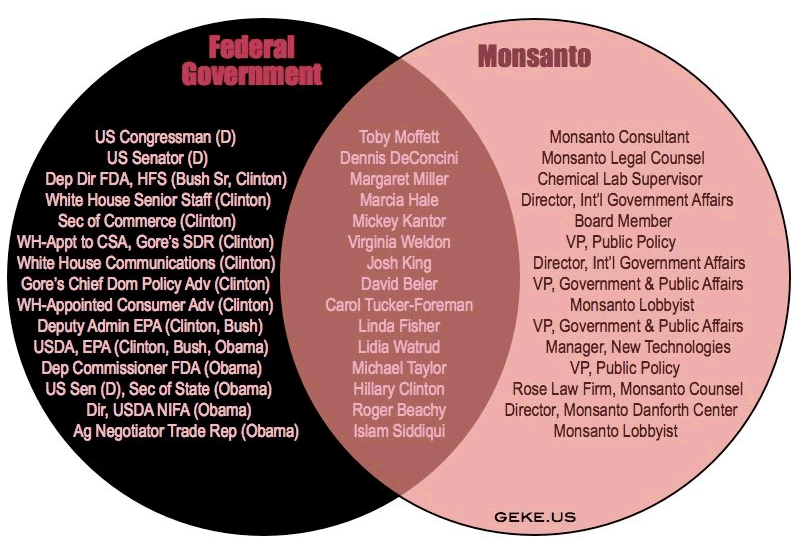
Due to the vested interest that Monsanto has in controlling regulation that affects its business, it has both donated to politicians and promoted the appointment of people who work for them to positions within the American government. As of yet, Monsanto has been successful in keeping its regulatory burdens low and getting its representatives into positions within the US government. The infiltration of regulatory agencies by corporate actors that is referred to here is called the “regulatory revolving door”. Individuals who work for industry go to work for the government, make public regulations, and then return to the private sector after leaving the public service. The following info-graphic gives a few examples of the revolving door between Monsanto and the United States government:

All Credit for this Venn diagram goes to Geke.us

While there are numerous points of overlap between Monsanto and the United States Government under the Obama administration, the three most important connections are that of Michael Taylor, Roger, Beachy, and Islam Siddiqui—all three of these Monsanto affiliates were appointed to high level positions within the government by the Obama administration.

The Obama administration appointed Michael Taylor, the previous vice president of Monsanto and a current Monsanto lobbyist, to a high level advisory role at the Food and Drug Administration [FDA]. It is virtually inarguable that this appointment constitutes a massive boon for Monsanto and an undeniable conflict of interest for Taylor. Given the fact that Taylor is a lobbyist for Monsanto and is being paid by the agro-giant, it is reasonable to assume that his advice to the FDA is focused upon helping his employer reduce its regulatory burden and improve its profitability. It isn’t a secret who Taylor worked for and we can assume that the Obama administration knew who they were appointing when they did it.

Roger Beachy, the Director of the Danforth Plant Science Center (a Monsanto organization), was appointed by the Obama administration as the Director of the USDA’s National Institute of Food and Agriculture. NIFA is a department of the USDA which focuses on funding research and innovation in the field of agriculture as well developing more efficient ways to produce food. As the major grant-writing division of the USDA, the NIFA department has the ability to grant or reject agricultural research grants. By giving Beachy the Directorship of the NIFA, the Obama administration gave a Monsanto associate the most powerful position in the organization which allocates agricultural research grants. Needless to say, this appointment is a great boon for Monsanto and bad news for any group which disagrees with the agri-business giant.

Islam Siddiqui, a Monsanto lobbyist, was appointed to the post of Agriculture Trade Representative by the Obama administration. Trade representative are tasked with promoting trade of goods within their appointed field (ex. Agricultural trade reps promote the export of American crops). As Monsanto has a controlling interest in American corn production, the appointment of a Monsanto lobbyist to the position of trade representative is a large boon for the corporation. Siddiqui’s government job is to promote the export of American crops and his Monsanto job is to promote the sale of Monsanto crops—it is undeniable that these two jobs present a conflict of interest and will only lead to Siddiqui representing Monsanto’s interests as though they are the interests of the United States.

Appointment of Elena Kagen

The justices that a president appoints to the Supreme Court is one of their most enduring and important contributions to the United States that every president gives the country. During his first term, President Obama appointed two Justices, one of whom was Elena Kagan, the former Solicitor General of the United States. During her time as the Solicitor General, Kagan filed a brief in support of Monsanto.

In 2007, Monsanto was brought to court by growers of alfalfa in California—these growers alleged that their crops were being cross-pollinated with, and thus contaminated by, Monsanto’s GMO crops. After winning an initial legal victory and securing an injunction on Monsanto’s planting of its modified alfalfa, Monsanto appealed the ruling and the case eventually reached the Supreme Court. Despite the fact that the United States government had no interest in the Monsanto alfalfa case, Kagan, the solicitor general wrote an “amicus” brief in favor of Monsanto’s position.

Nobody knows why the Solicitor General’s office decided to get involved in the Monsanto alfalfa case, but it was an unusual act by a supposedly neutral body; there was no rational reason for the US government to get involved in this case. While we don’t know the reason for this brief, it does make many believe that Kagan may be sympathetic to Monsanto’s corporate interests.

Candidate Mitt Romney has a very long history with Monsanto and has shown a willingness to work with the agro-conglomerate if elected president. Throughout much of his business career, Romney was heavily involved with the internal operations of the Monsanto Corporation. During Romney’s private sector experience at Bain Capital, he worked for and had a significant amount of influence upon the activities of the Monsanto Corporation. In addition to the business connection between Romney and Monsanto, several officers of the Monsanto corporation have held private relationships with Romney and have contributed to his political aspirations.

Romney’s Business Connections with Monsanto

In 1977, Bain Capital—the company that Romney ran, and in which he made most of his money—was starting out as a corporate consulting firm; Monsanto was among the first major clients of Bain. The multi-million dollar relationship between Bain Capital and Monsanto lasted from 1977 to 1985 and had significant effects on both corporations. Bain Capital, and its officers, made large amounts of money through its relationship with Monsanto and gained a significant client with which to base its consulting practice upon. Monsanto was given business advice by Bain and the corporation’s recent successes in GMO produce are traceable back to the suggestions that Romney made to Monsanto administrators.

According to Dr. Earl Beaver, Monsanto’s Waste Director during much of the 1970s and 80s, Romney was one of the major proponents of Monsanto’s shift into the biotechnical and bioengineering industry. In response to the massive scandal surrounding Monsanto’s part in the creation of “Agent Orange” (a powerful chemical weapon that was used during the Vietnam War), Romney suggested to Monsanto Administrators that they focus on businesses that had lower levels of controversy surrounding them then the creation of chemical weapons—this shift would reduce the negative press received by the company and would help improve the public perception of the company (thus helping them make more money). The creation of bioengineered organisms was a developing industry during the late 20th century and Monsanto—partly on Romney’s advice—began to invest in their GMO production divisions as a new industry.

Patrick Graham, a founding member of Bain Capital, said the following about Romney’s work with Monsanto: “The most important contribution Bain made to Monsanto was concluding that the biggest opportunity was to bring an entirely new value product, namely biotech and herbicides, to the whole farming industry in America, soybeans and stuff.”

If the officers who worked at Monsanto are to be believed, Romney had significant influence on the corporate decision-making for Monsanto and it is his advice that convinced the company’s leadership deciding to focus on GMO creation rather than simply pesticides. Romney saw a move into GMOs as a way to move away from the controversies of Agent Orange and DDT, thus improving the perception of the company.

While there are many ways that people could look at Romney’s history (those who dislike GMOs will blame him for helping create the largest GMO creator, while those who worked with Monsanto would likely thank him for the profitable business advice), there are two things that one can be reasonably certain about a Romney presidency and Monsanto:

  1. Romney suggested that Monsanto shift its industry to GMO creation, thus it is undeniable that he sees GMOs as a good investment; if he didn’t see GMO’s as a good way to make money he would never have suggested that Monsanto enter into GMO creation during his tenure as a consultant. Romney’s private sector support for GMOs will shade all of Romney’s policies in favor of GMOs and will make it very difficult to convince him to support any anti-GMO bills.
  2. Romney worked for Monsanto for years and has numerous contacts within the company. If Romney is elected, Monsanto will get unprecedented access to the president, if only due to the fact that Romney’s experience in agriculture was shaped by his work at Monsanto with Bain (his agriculture experience comes solely from Monsanto and not from working around other farming organizations). We see this access already, in the selection of several high-level Monsanto agents for advisory posts in the Romney campaign.

Monsanto Connections Within the Romney Campaign

Romney and his campaign have had significant contact with the Monsanto Corporation and have received support from Monsanto officers. While Romney has yet to hold a national office (his governorship in MA didn’t expose him to lobbying by many agri-business groups), his campaign for president has shown high levels of cooperation with the agri-business industry as well as the corn lobby.

Arguably the most significant aspect of the Romney campaign’s involvement with Monsanto comes from his appointments to his “Agricultural Advisory” committee. This committee, which is tasked with advising Mitt Romney on all issues relating to agriculture and agri-business, is staffed by “experts” on the field. The experts who staff Romney’s advisory committee come directly from the agro-business industry and represent a huge level of cooperation between Romney and big agri-business.

Randy Russell, a top lobbyist for Monsanto Co., has been appointed to this committee and will likely remain on if Romney wins the election. Russell’s involvement in Romney’s agricultural advisory committee represents a direct line between the Romney campaign (and thus his presidency) and the Monsanto Corporation. The simple fact that the top lobbyist for Monsanto has been given an advisory job with the Romney campaign is not unprecedented, but it does pose the worrying question: Where does the Romney agricultural policy begin and the lobbying efforts of Monsanto end?

In addition to Russell, the Agricultural advisory Committee is staffed with numerous other agri-business supporters:

Chuck Connor – The former leader of the Corn Refiners Association; this is the largest interest group for ethanol and corn syrup producers within the United States.

Bill Even – The former head of the DuPont Chemical “high-tech seed” division, which manages DuPont’s GMO seed business.

Chris Policinski – The CEO of “Land O Lakes” and a party to the 2007 GMO alfalfa case in California.

Tom Nassif – The leader of the Western Growers Association who has been the recipient of thousands of dollars in donations from the Monsanto Fund.

Tom Johanns – A senator from Nebraska who has taken nearly $10,000 in campaign contributions from Monsanto and who advocated in favor of blocking GMO labeling during the early 2000s push by the EU to mandate disclosure.

Partisanship and Money

The presidential election is important, but it does not exist in a vacuum—the views of a candidates’ party are extremely important to the eventual policy that they will push for in the legislature. The modern Republican Party has become focused upon the policies of reducing corporate taxes and reducing regulations on industry. Tax cuts and deregulation of industry standards are both immensely beneficial to large corporations, such as Monsanto. While it has significant control over regulators through its revolving-door appointees, Monsanto is still vulnerable to regulations on its business.

Of the two major American political parties, the Republicans promote deregulation, while the Democrats support regulatory increases (or sometimes simply retention of current regulations). If elected, it is virtually certain that Romney will sign off on his party’s platform of deregulation and tax cuts. Nothing in his history has indicated that Romney will buck his party on issues of legislation, and it appears that a Romney presidency would allow the Republican legislature to pass pro-corporate legislation without fear of veto.

In the last electoral cycle, the Republicans in the legislature have taken $226,000 from Monsanto Co., while Democrats have taken only $90,500 (for a full list, sorted by candidate, follow this link). It is clear that the Republicans, as a party, are friendlier to Monsanto’s interests than the Democrats and would likely have more favorable policy outcomes if the Republicans had control over policy.

Conclusion

When all things have been considered, it is undeniable that Monsanto has significant influence over both major parties in the United States—the only real difference between the candidates is how deep this influence goes. Regardless of whether it is Obama or Romney who becomes the next president, it appears that Monsanto will continue to have significant power in Washington politics and will retain a very high level of lobbying influence.

Opinion Based Conclusions

Past this point, the article focuses on my analysis of Romney and Obama’s involvement with Monsanto and is largely opinion.

When all things are taken into account, a Romney presidency is likely better for Monsanto than an Obama presidency: Obama has shown an unwillingness to confront Monsanto, but Romney appears to have a much deeper connections to Monsanto and be more willing to promote things that will actively benefit the company. Here are a few areas of comparison between the Romney and Obama presidencies in regard to Monsanto:

Donations: While it is often difficult to unravel the massive web of political money, much of which has been filtered through SuperPACs, we know that Romney has taken significantly more money from agro-businesses than Obama. According to OpenSecrets.org, Mitt Romney has taken $4,075,531 in campaign contributions from America agribusinesses, while Barack Obama has only taken $1,377,503 from these interests. As you can see, both candidates are in bed with agribusiness corporations to some degree, but Romney has taken nearly 3X the money that Obama has from this particular industry. It is important to note that these numbers are likely far lower than the actual amounts donated because a majority of the money which is spent by SuperPACs is dark money, where there is no source disclosure. The massive disparity in agribusiness fundraising between the candidates points to the preference of these corporations that Romney get the presidency. As corporations donate money to politicians as an investment and to sway policy in their favor, it is clear that they prefer the Romney vision to the Obama vision.

Partisanship: The president is important, but the legislature is where policy is made; as such, the party affiliations of the presidential candidates can be extremely determinative of the policy that will be passed. Romney is a Republican and Obama is a democrat, and the winner of the presidency will likely be able to sway the national agenda in favor of their party. In the last electoral cycle, the Republicans in the legislature have taken $226,000 from Monsanto Co., while Democrats have taken only $90,500 (for a full list, listed by candidate, follow this link). The Republican Party is based in the center of the country and the south, much of which is dependent upon farming for its primary industry—due to this dependency upon agricultural interest, the Republicans are far more politically friendly towards agribusiness than the Democrats and more likely to support companies like Monsanto.

In addition to the partisan funding disparity, it bears mention that the Republican Party is unified around the ideals of lowering taxes and reducing regulations. Reducing corporate taxes and removing regulations (ex. FDA rules), benefits large corporations and their owners, thus these corporations tend to support Republicans more than Democrats.

A Romney presidency will allow the Republicans to pass corporate friendly legislation without fear of veto. This streamlining of the legislative process reduces the difficulty of passing laws (and removing regulations) that benefit Monsanto, and will lead to more favorable outcomes for the corporation—It appears that Monsanto knows this, and has invested its political contributions accordingly.

Regulation: Neither Obama nor Romney appears to be willing to take on agribusiness interests in order to increase regulations, but there is a key difference in their stances: Obama is largely neutral in his actions towards regulations on Monsanto, while Romney is actively invested on deregulating the industry.

Appointments: Both Obama and Romney have shown their willingness to appoint corporate agents to high level advising positions within the government—Obama appointed Michael Taylor to the FDA and Romney has named several Monsanto lobbyists as his agricultural advisory board. At this point, we don’t know who would be worse in regard to appointments, but neither choice is particularly encouraging.

http://theprogressivecynic.com/2012/11/05/no-matter-who-wins-the-2012-presidential-election-monsanto-benefits/

2 Articles on “Monsanto Protection Act” by Anthony Gucciardi


Monsanto Protection Act Signed By Obama, GMO Bill “Written By Monsanto” Signed Into Law
by Anthony Gucciardi


The Monsanto Protection Act, essentially both written by and benefiting Monsanto Corporation, has been signed into law by United States President Barack Obama. The infamous Monsanto Corporation will benefit greatly and directly from the bill, as it essentially gives companies that deal with genetically modified organisms (GMOs) and genetically engineered (GE) seeds immunity to the federal courts, among other things.

The bill states that even if future research shows that GMOs or GE seeds cause significant health problems, cancer, etc, anything, that the federal courts no longer have any power to stop their spread, use, or sales.

There are of course arguments to be made that not enough research has been done yet to accurately determine the effects that GMOs have on human and animal health (though the research already done should make you stop and think). This bill sidesteps that completely though, and simply states that even if there are problems, that the federal courts can no longer do anything about it. And this bill is now law, thanks to President Obama and the U.S. Congress.

Some other interesting things to keep in mind:

- The bill was apparently written by freshman Sen. Roy Blunt in collusion with Monsanto, with them helping to craft the exact language of the document.

- “The Center for Responsive Politics notes that Sen. Blunt received $64,250 from Monsanto to go towards his campaign committee between 2008 and 2012. The Money Monocle website adds that Blunt has been the largest Republican Party recipient of Monsanto funding as of late.”

- Many members of Congress were apparently unaware that the “Monsanto Protection Act” was a part of the spending bill that they were voting on.

- Obama had no problem signing it into law (not really a surprise, he’s been rather soft on GMO policy).

- The bill will only remain in effect for a limited time, but it’s a bad sign. With the ease that this bill passed, it’ll be interesting to see what future bills look like.

As the Daily News asks, “Who’s more powerful, the world’s largest producer of genetically modified crops or the U.S. government?”

“On Tuesday, Pres. Obama inked his name to H.R. 933, a continuing resolution spending bill approved in Congress days earlier. Buried 78 pages within the bill exists a provision that grossly protects biotech corporations such as the Missouri-based Monsanto Company from litigation.”

“In light of approval from the House and Senate, more than 250,000 people signed a petition asking the president to veto the spending bill over the biotech rider tacked on, an item that has since been widely referred to as the ‘Monsanto Protection Act.’”

“But Obama ignored [the petition],” as the IB Times notes, “instead choosing to sign a bill that effectively bars federal courts from being able to halt the sale or planting of GMO or GE crops and seeds, no matter what health consequences from the consumption of these products may come to light in the future.”

GMOs, while they may cause problems for human health, are primarily a problem for other reasons, mostly to do with crop/genetic diversity and overly complex industrial systems. And also the fact that they often don’t even work the way that they are “supposed” to.

When taken in context though, GMOs are really just another in a long line of environmentally damaging practices that people have done for short term gain/profit. From the large-scale deforestation of the world’s old-growth forests, to sustenance farming, to modern imported-fertilizer/pesticide/herbicide/fossil-fuel dependent industrial agricultural, the trend has been consistent, GMOs are just another in that line of attempts to temporarily maintain/raise crop yields. Regardless of the type of agriculture or the location, there are limits to how long any land can remain productive, applying imported fertilizers, or utilizing GMOs, only provides, at best, a temporary halt to the land’s transition to non-productive “wasteland”, and to desertification.

http://planetsave.com/2013/03/30/monsanto-protection-act-signed-by-obama-gmo-bill-written-by-monsanto-itself-signed-into-law/#3ReO3JSPSTXKzMRQ.99


Obama Signs Monsanto Protection Act into Law after Promising GMO Labeling in 2007
by Anthony Gucciardi

President Obama has signed into law the notorious Monsanto Protection Act legislation hidden inside of the Continuing Resolution spending bill, which protects Monsanto and its genetically modified creations from federal courts.

Passing up the chance to veto the bill in favor of stopping Monsanto’s increasing monopoly on the food supply, Obama pushed the bill through into a law in a move that reminds us of his failed 2007 promise to ‘immediately’ label GMOs upon his election.

Contained in the rider (Farmer Assurance Provision, Sec. 735) of HR 933, Monsanto is now even protected (at least under this law) from the United States government.

As I pointed out in a previous article, the Monsanto Protection Act’s success actually proves how corporations have more power than even the United States federal government. Monsanto’s lobbyists managed to slip the rider into the major bill, which — despite the rider — has virtually nothing to do with the topic.

This is a typical and routinely practiced move by lobbyists to insert an incognito line of legislation into a bill generally viewed as favorable overall. One that has proven to be effective for Monsanto.

2007 Promise to Label GMOs

The result is now major outcry against Obama for signing the bill into law and protecting the biotech juggernaut Monsanto. Many fail to remember, however, that Obama first decided to allow Monsanto to continue pulverizing the food supply and the health of the nation back in 2008 when he went back on his promise to ‘immediately’ label GMOs. It was in 2007, during a campaign speech, that Obama first stated his support of non-GMO and GMO labeling activists, in which he promised to swiftly label GMOs.

You can see the video from our Youtube channel here.

For a brief period before the bill was passed by the Senate and now signed into law by Obama, both myself and many others in the alternative news community crusaded tirelessly to alert politicians and activists in order to stop the Protection Act from going through. Unfortunately, time was not on our side. The hasty vote by the Senate and the news blackout from the mainstream media were enough to break through the warnings of concerned activists (and people who just want real food). Now, however, renewed interest in the GMO labeling campaign and the fight against Monsanto brews.

With such a blatant and cocky act against the United States and its people, Monsanto has set itself up to fail. Let’s remind Obama of his promise to label GMOs he made many years ago.

http://intellihub.com/2013/03/28/obama-signs-monsanto-protection-act-into-law-after-promising-gmo-labeling-in-2007-2/

GMO and Monsanto: Glyphosate Weed Killer Found in Human Urine across Europe

By Friends of the Earth


People in 18 countries across Europe have been found to have traces of the weed killer glyphosate in their urine, show the results of tests commissioned by Friends of the Earth Europe and released today [1].

The findings raise concerns about increasing levels of exposure to glyphosate-based weed killers, commonly used by farmers, public authorities and gardeners across Europe. The use of glyphosate is predicted to rise further if more genetically modified (GM) crops are grown in Europe [2].

Despite its widespread use, there is currently little monitoring of glyphosate in food, water or the wider environment. This is the first time monitoring has been carried out across Europe for the presence of the weed killer in human bodies.

Friends of the Earth Europe’s spokesperson Adrian Bebb said:

“Most people will be worried to discover they may have weed killer in their bodies. We tested people living in cities in 18 countries and found traces in every country. These results suggest we are being exposed to glyphosate in our everyday lives, yet we don’t know where it is coming from, how widespread it is in the environment, or what it is doing to our health.

“Our testing highlights a serious lack of action by public authorities across Europe and indicates that this weed killer is being widely overused. Governments need to step-up their monitoring and bring in urgent measures to reduce its use. This includes rejecting any genetically modified crops that would increase the use of glyphosate.”

Friends of the Earth Europe is calling on the European Union to urgently investigate how glyphosate is finding its way into people’s bodies; to increase the levels of monitoring in the environment and in food and water; and to introduce immediate restrictions on the use of glyphosate.

Friends of the Earth Europe commissioned laboratory tests on urine samples from volunteers in 18 countries across Europe and found that on average 44% of samples contained glyphosate. The proportion of positive samples varied between countries, with Malta, Germany, the UK and Poland having the most positive tests, and lower levels detected in Macedonia and Switzerland.

All the volunteers who provided samples live in cities, and none had handled or used glyphosate products in the run-up to the tests which were carried out between March and May 2013.

Glyphosate is used on many genetically modified crops. 14 new GM crops designed to be cultivated with glyphosate are currently waiting for approval to be grown in Europe. Approval of these crops would inevitably lead to a further increase of glyphosate spraying in the EU.

The biggest producer of glyphosate is Monsanto which sells it under the brand name ‘Roundup’. Two weeks ago the US Department of Agriculture announced that it had found GM wheat developed by Monsanto that has not been approved anywhere in the world growing in a field in Oregon, leading to some countries restricting or testing US wheat imports and farmers in the US starting legal cases against the company.

Notes:

[1] Urine samples were collected from volunteers in Austria, Belgium, Bulgaria, Croatia, Cyprus, Czech Republic, France, Georgia, Germany, Hungary, Latvia, Macedonia, Malta, Poland, Spain, Switzerland, The Netherlands, and the UK. A total of 80/182 samples tested were found to contain glyphosate. Volunteers were all city-dwellers and included vegetarian and non-vegetarian diets. No two samples were tested from the same household. The samples were analyzed by Dr Hoppe at Medical Laboratory Bremen in Germany.

The full results of ‘Determination of Glyphosate residues in human urine samples from 18 European countries’ by Medical Laboratory Bremen are available online.  

http://www.foeeurope.org/weed-killer-glyphosate-found-human-urine-across-Europe-130613